
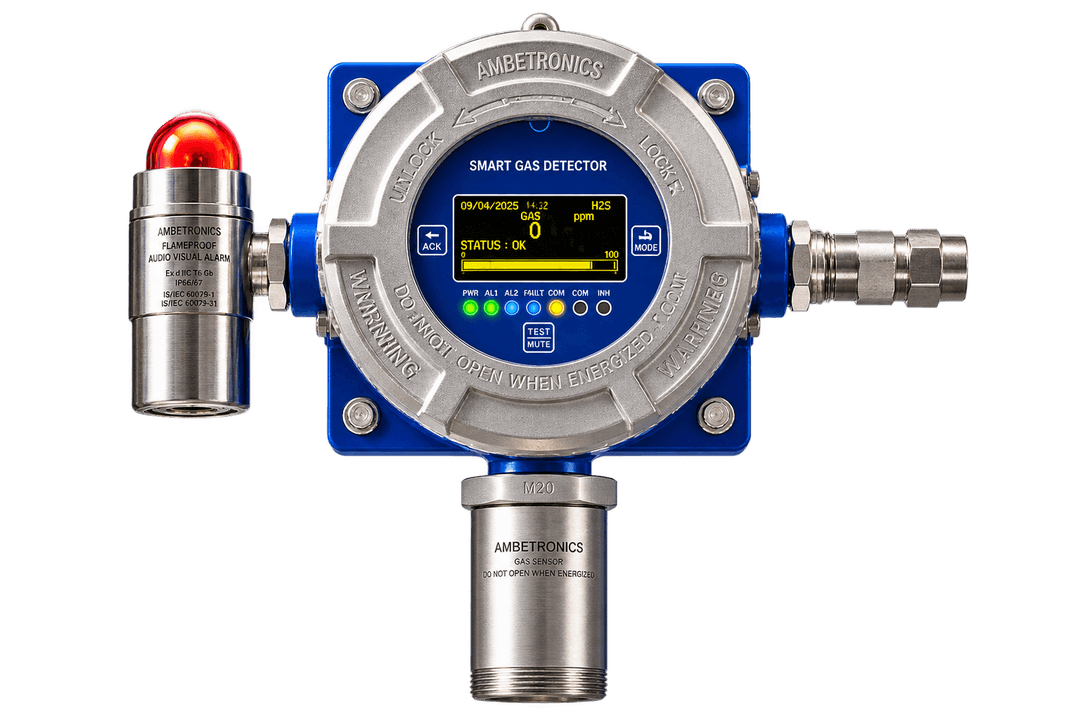
No products match your search.
UV Flame Detectors
Browse our certified range of UV Flame Detectors, engineered for reliable, continuous monitoring in demanding industrial environments. Filter by specification below to find the right system for your site.
Available Products
Showing 0–0 of 0 products
How It Works
How UV Flame Detection Works
UV Flame detectors continuously sample the surrounding atmosphere and respond the moment a hazardous concentration is present, triggering a local and remote alarm before the condition becomes dangerous.
How does it work?
What It Monitors
Continuously samples the ambient air at the installation point, watching for the target gas or hazard to reach a pre-set alarm threshold.
Sensor Response
The sensor reacts to the presence of the hazard with a measurable signal change, which the detector's electronics convert into a concentration reading.
Sensor Technology
Depending on the hazard, the detector may use electrochemical, catalytic (pellistor), infrared (NDIR), PID or solid-state sensing. The technology is selected to suit the specific gas and environment.
Alarm Communication
Once a threshold is crossed, the detector raises a local visual/audible alarm and transmits the event via 4-20mA, relay or Modbus to the control room or SCADA system.
Applications & Risk Areas
Where UV Flame Detectors Are Used
UV Flame Detectors are installed wherever the hazard can accumulate, leak or be generated as part of normal operations. The exact installation areas depend on your site's process and layout.
Oil & Gas Facilities
Process areas, wellheads and pipeline routes where flammable or toxic gases may be present.
Chemical Processing Plants
Reactor, storage and handling areas where process chemicals present a leak or exposure risk.
Power & Utility Plants
Turbine halls, fuel handling and utility areas requiring continuous hazard monitoring.
Water & Wastewater Treatment
Chlorination, dosing and confined treatment areas where toxic gases can accumulate.
Manufacturing & Process Areas
Production lines and process equipment where combustible or toxic byproducts are generated.
Offshore Platforms
Wellhead, process and accommodation modules requiring certified hazardous-area detection.
Storage & Warehousing
Bulk storage, tank farms and warehousing areas holding hazardous or flammable materials.
Confined Spaces & Utility Rooms
Enclosed, poorly ventilated spaces where gas can accumulate quickly and go undetected.
Detector Types
Detector Types & How to Choose
Start by deciding how the detector will be used: permanent area monitoring or portable personal protection. Then confirm the number of gases, target gas, sensor technology, hazardous-area requirements and system integration.
Specifications
Key Features, Specifications & Environmental Suitability
Gas detector selection depends on three factors: the features that support operation, the specifications that match the gas hazard, and the environmental limits that determine reliable field performance. Confirm the exact gas, sensor technology, measuring range, enclosure and output configuration before approving any detector.
Gas detector features determine how operators monitor gas levels, receive alarms, identify faults and connect the detector to a wider safety or control system.
How are the gas and sensor configurations selected?
Gas detectors use specific combinations of gases and sensor technologies. A detector that supports several sensor technologies does not automatically detect several gases at the same time. The selected sensor module determines the gas, measuring range and measurement unit.
- Electrochemical: Oxygen and selected toxic gases
- Catalytic bead / Pellistor: Combustible gases
- NDIR: Carbon dioxide and compatible hydrocarbon gases
- PID: Volatile Organic Compounds (VOCs)
- Semiconductor / MOS: Selected gas-leak applications
How does a gas detector show readings and alarms?
Gas detectors use local displays and alarm indicators to give operators immediate information about gas concentration, detector status and fault conditions.
- LED or LCD display: Gas concentration, alarm status and fault information
- Status LEDs: Normal, alarm, calibration and system-failure states
- Audible alarms: Immediate warning when alarm thresholds are reached
- Visual beacons: Clear visual indication in industrial environments
- Hooter-cum-flasher: Combined audible and visual warning for noisy or high-risk areas
How does a gas detector identify faults and maintenance needs?
Built-in diagnostics continuously monitor the detector and sensor condition. These functions help maintenance teams identify problems before a monitoring point becomes unavailable.
- Sensor fault indication
- Over-range warning
- Calibration-due alert
- Calibration-failure alert
- Open-loop or communication fault
- Sensor-replacement warning
- LED, relay and output test modes
- Replaceable or pluggable sensor modules
How does a gas detector connect to a control system?
Gas detectors transmit gas readings, alarms and fault signals to gas-detection controllers, PLCs, DCS platforms, SCADA systems, BMS panels and shutdown systems. The selected output must match the existing control-system architecture and alarm requirements.
- 4–20 mA: Analogue gas concentration signal
- Relay contacts: Alarm and fault switching
- RS-485: Digital communication
- Modbus RTU: Integration with compatible control systems
- HART: Digital communication over compatible analogue loops
- Local alarm outputs: Connection to external warning devices
How are gas detectors calibrated and programmed?
Calibration verifies the detector response using a certified concentration of test gas. Programming functions allow technicians to configure alarm levels, outputs and detector settings. Non-intrusive magnetic programming allows configuration without opening a compatible flameproof enclosure, simplifying routine setup and maintenance.
- Non-intrusive magnetic programming
- Password-protected configuration
- Calibration records
- Stored sensor data
- Alarm and output configuration
Gas detector specifications define whether a product is technically suitable for the target gas, measuring range, installation method, power supply and hazardous-area requirement.
Which gas is the detector designed to monitor?
The exact gas or gas category must be confirmed before selection. Terms such as combustible gas or toxic gas describe broad groups and do not confirm compatibility with every gas within that group. The selected detector configuration must match the exact gas present at the site.
- Combustible gases
- Toxic gases
- Oxygen
- Carbon dioxide
- Volatile Organic Compounds (VOCs)
Which measuring range and unit does the application require?
The measuring range must match the expected gas concentration and monitoring objective. Different units represent different types and levels of gas concentration. A detector configured for ppm monitoring performs a different function from one configured for %LEL or %V/V monitoring.
- %LEL: Combustible gas concentration
- ppm: Low-level toxic gas and VOC monitoring
- %V/V or %Vol: Oxygen, carbon dioxide and higher gas concentrations
- mg/m³: Mass-based gas concentration
Which sensor technology is suitable for the gas?
Sensor technology determines gas compatibility, response behaviour, maintenance requirements and resistance to contaminants. The gas and sensor must be selected together. A suitable enclosure cannot compensate for an unsuitable sensor technology.
- Target gas
- Measuring range
- Oxygen availability
- Cross-sensitivity
- Sensor-poisoning risk
- Expected humidity
- Operating temperature
- Required service life
How quickly must the detector respond?
Response time defines how quickly the detector reaches a specified percentage of the final reading after exposure to gas. Product datasheets commonly express response as T50 or T90. Always use the response time stated for the selected gas and sensor configuration.
- Gas type
- Sensor technology
- Diffusion or pumped sampling
- Filter condition
- Airflow
- Temperature
- Detector placement
Which detector type matches the monitoring requirement?
The detector format must match how and where gas monitoring will take place. A configurable single-gas detector remains a single-gas detector even when different sensor options are available.
- Fixed detector: Continuous monitoring at a permanent location
- Portable detector: Personal safety, confined-space entry and mobile gas checks
- Standalone wall-mounted detector: Local monitoring in kitchens, utility rooms and smaller premises
- Multi-gas detector: Simultaneous monitoring through multiple sensing channels
What power and wiring does the installation require?
Power and wiring determine how the detector is installed and connected to the wider system. Confirm the supply voltage, cable type, current consumption, loop resistance and backup-power requirement before installation.
- 24 V DC
- 2-wire loop-powered
- 3-wire
- 4-wire
- Battery-powered
- Wireless communication
Which enclosure and IP rating does the site require?
The enclosure protects the detector from environmental and mechanical exposure. The IP rating defines protection against dust and water. It does not certify the detector for use in an explosive atmosphere.
- Flameproof or explosion-protected
- Weatherproof
- Safe-area
- IP65
- IP66
- IP67
- IP68
Which hazardous-area certification is required?
Hazardous-area certification confirms that the selected detector configuration is suitable for a defined installation environment. The required certificate must match the exact detector model, enclosure configuration and project requirement. Certification should be verified for the selected product, not assumed from the wider product family.
- ATEX
- IECEx
- PESO
- SIL 2
- CE
Environmental suitability determines whether the gas detector remains accurate, accessible and serviceable at the installation point.
What operating temperature must the detector withstand?
Every gas detector has a defined operating-temperature range. The selected detector must cover the site's minimum and maximum ambient temperature. A detector used outside its rated temperature range can lose measurement accuracy and reliability.
- Direct sunlight
- Process heat
- Seasonal temperature changes
- Outdoor exposure
- Enclosed hot or cold areas
How much humidity and condensation can the detector handle?
Humidity affects sensors, filters, electronics and electrical connections. The detector must match the site's actual moisture conditions. An IP-rated enclosure protects the electronics from water ingress, but the sensor opening must remain exposed to the atmosphere being monitored.
- Relative humidity limit
- Non-condensing requirement
- Outdoor exposure
- Washdown conditions
- Condensation risk
- Cable-gland protection
Is the detector suitable for dust, water and corrosive environments?
Dust, salt, chemicals and corrosive vapours can shorten detector life when the enclosure and sensor materials do not match the environment. Marine facilities, chemical plants, wastewater treatment sites and fertiliser plants require particular attention to corrosion resistance and enclosure construction.
- Enclosure material
- Sensor housing
- Protective filters
- Cable glands
- Protective coatings
- Stainless-steel accessories
Is the detector approved for the hazardous area?
A detector installed in Zone 0, Zone 1 or Zone 2 must carry the appropriate hazardous-area approval for that location. Hazardous-area suitability and environmental protection are separate requirements. A weatherproof detector is not automatically suitable for an explosive atmosphere, and an explosion-protected detector is not automatically suitable for continuous water exposure. Both the hazardous-area certification and environmental protection rating must match the site.
Where should the gas detector be installed?
Detector placement determines whether leaked gas reaches the sensor quickly enough to provide useful warning. Mounting height should not be based on gas density alone — air movement, temperature and leak momentum also affect how gas travels through the area.
- Gas density
- Likely leak source
- Release pressure
- Gas temperature
- Mechanical ventilation
- Natural airflow
- Structural obstructions
- Roof spaces, pits and enclosed pockets
- Access for calibration and maintenance
Can vibration or electrical interference affect the detector?
Compressors, pumps, motors and heavy machinery create vibration and electromagnetic interference around industrial installations. These factors help maintain stable detector operation in demanding industrial environments.
- Mounting hardware
- Cable routing
- Electrical shielding
- Grounding
- Enclosure protection
Can the detector be easily accessed for maintenance?
Every detector must remain accessible for routine inspection and servicing. A poorly positioned detector increases service time and can leave the monitoring point unavailable for longer during maintenance.
- Bump testing
- Calibration
- Sensor replacement
- Cleaning
- Filter inspection
- Electrical checks
Need Help Selecting the Right Detector?
Share your hazard, application and installation requirements. A Yamin Global engineer will help identify the suitable detection system.
Talk to an Engineer
Installation & Maintenance
Installation, Placement & Maintenance
Correct placement depends on the specific hazard, gas behaviour, site airflow, equipment layout and applicable project or code requirements. There is no single universal mounting distance that applies to every facility. Our engineering team can confirm placement as part of your project.
Installation & Placement
Mounting location, height and orientation are set based on the hazard's density and behaviour, airflow patterns and nearby equipment while avoiding dead zones, direct weather exposure and sources of interference.
Commissioning & Calibration
Every detector is functionally tested and calibrated against a certified reference gas at commissioning, and re-calibrated on a schedule appropriate to the sensor technology and site conditions.
Routine Testing & Maintenance
Periodic bump tests, sensor inspection and preventive maintenance keep the detector within specification between full calibrations, with sensor replacement scheduled around expected service life.
Cost
What Affects UV Flame Detector and Maintenance Cost?
Rather than a single fixed price, total cost depends on several project-specific factors:
- Detector type (fixed vs. portable)
- Certification requirements
- Number of detection points
- Installation
- Sensor replacement
- Detector type (fixed vs. portable)
- Certification requirements
- Number of detection points
- Installation
- Sensor replacement
- Sensor technology
- Enclosure rating
- Controller / SCADA integration
- Calibration
- Ongoing maintenance
- Sensor technology
- Enclosure rating
- Controller / SCADA integration
- Calibration
- Ongoing maintenance
Why Yamin Global
Why Choose Yamin Global
We support your project beyond the datasheet, from selecting the right system to keeping it running reliably after commissioning.
What Yamin Global Provides
- Engineer-Led Selection. We review your hazard, site conditions and integration needs before recommending a system.
- Certification Guidance. We help confirm the ATEX, IECEx, SIL 2, PESO or CE certification your project requires.
- Integration Support. Guidance on wiring, outputs and SCADA/controller integration for a smooth installation.
- Commissioning & Calibration. On-site support for commissioning, functional testing and initial calibration.
- Technical Documentation. Datasheets, certificates and manuals organised for your project records.
- After-Delivery Support. Ongoing technical assistance for calibration, spares and servicing.
What Others Provide
- Systems sold off a catalogue, with little review of your hazard or site conditions.
- Certification requirements left for you to work out on your own.
- Minimal guidance on wiring, outputs or SCADA/controller integration.
- No on-site commissioning, functional testing or calibration support.
- Datasheets and certificates scattered, incomplete, or chased down separately.
- Support ends once the invoice is paid.
What buyers usually need to know
The correct detector depends on the gas or hazard, installation area, environmental conditions, required certification, measuring range and integration method. Share these details with Yamin Global for an engineer-led recommendation.
Yes. Applicable products may be available with certifications and approvals such as ATEX, IECEx or SIL 2. Availability depends on the selected product and project requirement, so certification should be confirmed during specification.
Yes. Support can include product specification, commissioning, calibration, pre-handover checks and the relevant project documentation.
Suitable systems can provide industrial outputs such as 4–20 mA, Modbus RTU/TCP or OPC UA. The required protocol and plant architecture should be confirmed before selection.

Tell us what you need to detect or monitor
Share the hazard, application, site conditions and required standards. A Yamin Global engineer will review the information and help identify suitable products or the next technical step.